
How to spot early warning signs of financial distress
23 October 2026

As published in the October 2026 edition of Build Magazine.
.
Key takeaways
“Cash is king” – profitable projects can still create financial distress and liquidity pressures if progress claims, variations and retentions are not converted to cash.
Assess the financial capacity of clients – builders need to understand how a developer intends to fund a project, including reliance on debt, equity and pre-sales.
Know which subcontractors are critical – identify the trades and suppliers whose failure would materially affect program, cost or completion.
Operational issues are potential financial warning signs – reduced site attendance, delayed decisions, staff turnover and repeated payment disputes may indicate deeper problems.
Early intervention – acting early protects liquidity and provides more options to restructure projects, renegotiate contracts and protect the business.
.
Construction remains Australia’s largest source of corporate insolvencies
Australia’s construction sector has experienced sustained financial pressure over the past five years. Escalating material and labour costs, worker shortages, higher interest rates and delayed payments have placed significant pressure on margins and liquidity.
Recent administrations involving Bathla Group, Novati Constructions and Roberts Co highlight that even established operators can fail when project losses, funding constraints and liquidity pressures are not addressed early.
Since July 2024 more than one in four corporate insolvencies have occurred in construction, many of which relate to primary residential builders, subcontractors and construction service providers.
Builders should remain alert to early warning signs across the entirety of a project lifecycle – within their own business, among subcontractors and in the financial position of the project sponsor.
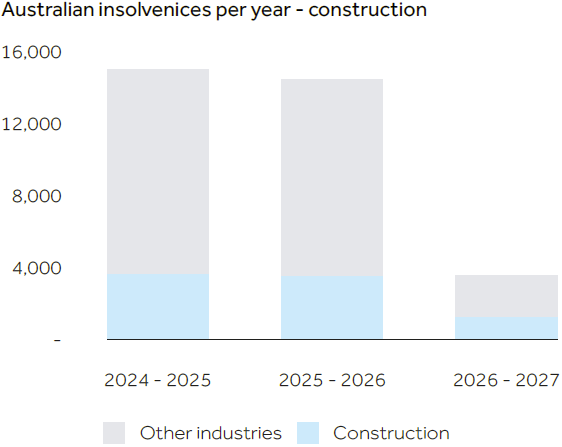 .
Source: ASIC insolvency statistics published 28 September 2026
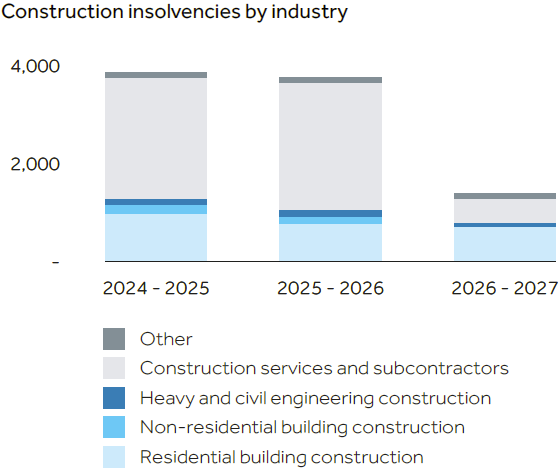 .
|Source: ASIC insolvency statistics published 28 September 2026
.
Start with your own business
Financial distress rarely begins when a payment is first missed. Warning signs typically emerge much earlier in project reporting, operational performance, cost-to-complete forecasts and gaps between profit and available cash.
A builder may report strong profitability while experiencing liquidity pressures. Variations and claims may support forecast margins but remain uncertified or unpaid.
Builders should therefore be asking:
Are project profits being converted into cash?
How much forecast profit depends on disputed or uncertified claims?
Are receivables and retentions continuing to grow?
Could the business withstand a major payment delay?
A reliable rolling 13-week cash flow forecast remains one of the most important liquidity tools available to management. Assumptions should be stress-tested for delayed payments, cost escalation, program slippage and unsuccessful claims so that builders can robustly understand their liquidity position and requirements.
Management needs confidence that problems are being identified and escalated quickly. A reporting culture that focuses on revenue and construction progress, but discourages the early reporting of cost overruns, can allow manageable project issues to become business-threatening issues.
.
Understand the capacity of your developer client
Builders routinely assess subcontractor risk but often undertake less diligence on the party ultimately responsible for payment. Before taking on a project, and throughout delivery, builders should understand how the project sponsor intends to fund the development.
Key questions include:
Is project funding sufficient to complete the works?
Can the developer absorb cost overruns?
Is funding reliant on pre-sales or refinancing?
Early warning signs can include delayed certification of progress claims, payment deferrals, slow approval of variations and frequent scope changes. In isolation, these events may have reasonable explanations. However, several occurring together may indicate that the project sponsor is conserving cash or experiencing funding pressure.
Where exposure is material, builders should consider appropriate protections, including shorter payment cycles, evidence of committed funding and clearly documented rights if payment or project funding is interrupted.
.
Monitor critical subcontractors and suppliers
The failure of a key subcontractor can quickly create cost overruns, delays and completion risks for a builder. Warning signs may include requests for accelerated payments, reduced labour on site, increasing payment disputes, delays in procurement and staff turnover.
The appropriate response is not always termination. Builders should assess the exposure, validate the issue and consider whether revised payment arrangements, direct procurement or contingency planning better protects project delivery. Any support provided to a subcontractor should be documented and tied to measurable delivery outcomes.
.
Early action protects options
When warning signs emerge, management should validate the cash position, update project forecasts and determine immediate funding requirements. Management should also identify the projects, clients and counterparties creating the greatest exposure.
Actions may include resolving outstanding claims, renegotiating uneconomic contracts, reducing overheads, obtaining additional capital, changing procurement arrangements or exiting noncore projects. Where financial distress is more advanced, early engagement with restructuring advisers, financiers and key stakeholders may preserve options that disappear once cash and confidence have been exhausted.
In the current market, a builder’s financial risk extends beyond its own balance sheet. The capacity of a developer to fund the project and the ability of subcontractors to deliver are equally important.
Builders that understand their project economics, monitor counterparties and respond early to warning signs will be best placed to navigate a challenging market. Restructuring mechanisms are most effective when action is taken early.
.